
Acne is frustrating enough while it is happening. Then it finally calms down, and sometimes it leaves behind something that lasts much longer than the breakout ever did.
Honestly, that part can feel worse.
I hear about microneedling constantly from clients dealing with acne scars. The question is usually some version of, “Does this actually work?” followed closely by, “Or is this just another skincare trend?”
Fair question. The aesthetics world is very good at making every new device sound revolutionary. A lot of treatments get talked about like they are going to completely change your skin, your life, possibly your taxes. Then six months later nobody mentions them.
Microneedling is different. I actually think it has earned most of the attention it gets.
Not all of it. But most.
What Microneedling Actually Does to the Skin
The basic concept is fairly simple.
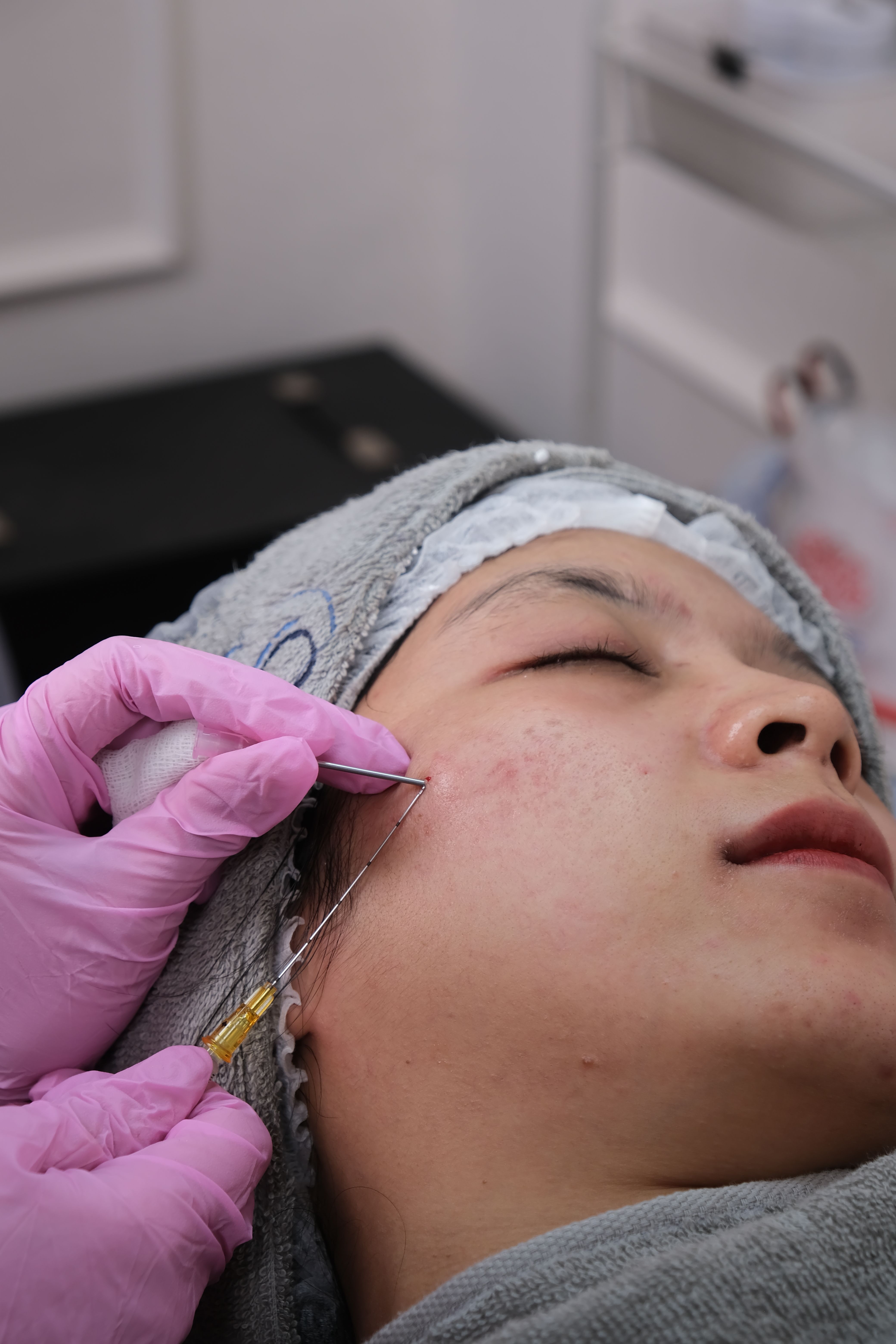
A microneedling device uses a group of very fine needles to create controlled micro-injuries in the skin. Your body recognizes those tiny injuries and starts a healing response, which includes producing new collagen and remodeling some of the collagen already there.
That collagen response is the entire point.
Indented acne scars form when inflammation damages the skin’s underlying support structure and the body does not replace enough collagen during healing. The surface closes, but it closes unevenly. A dip, a shallow crater, sometimes a narrow little scar that catches the light no matter what makeup you put over it.
Microneedling essentially asks the skin to go back and repair some of that unfinished work.
That is different from something like microdermabrasion, which mainly exfoliates the outermost layer of skin. Exfoliation can improve dullness and very superficial roughness, but it does not create the same deeper wound-healing response.
Microneedling reaches farther down. Not dramatically, not recklessly, but enough to stimulate remodeling where depressed scars actually live.
One thing I always tell people: this is not an instant treatment.
You are not walking out of one appointment with completely smooth skin. Usually you are walking out red, slightly swollen, and wondering whether you made a mistake for about twelve hours.
Then the redness settles.
The real improvement happens slowly over the following weeks and months while the skin rebuilds. Your body is doing the work. The device just starts the conversation.
Which Acne Scars Respond Best
Not every acne scar behaves the same way, and this matters much more than most people realize before treatment.
Microneedling tends to work best on atrophic scars, meaning scars that sit below the surrounding skin. These generally include rolling scars, boxcar scars, and some ice-pick scars.
Rolling scars often respond well because their edges are softer and the depressions are relatively broad. Boxcar scars can improve too, although deeper ones usually need more sessions or combination treatment.
Ice-pick scars are more stubborn.
They are narrow and deep, almost like tiny punctures in the skin. Microneedling may soften them, but I would be hesitant to promise dramatic improvement from microneedling alone. Some providers oversell that part. There are other procedures that may be better suited to very deep ice-pick scars.
Raised scars are a different issue entirely.
Hypertrophic scars and keloids form because the body produced too much collagen, not too little. Stimulating more collagen in that area is not automatically helpful and may not be appropriate.
This distinction gets glossed over on clinic websites more often than it should. “Acne scars” gets treated like one diagnosis when it is really several different problems that happen to share a name.
If the scar is raised, thick, itchy, or continuing to grow, that is a dermatologist conversation before it is a microneedling conversation.
What the Research Actually Shows
I do not like saying a treatment “works” without explaining what that actually means.
Research on microneedling for acne scarring generally shows improvement in scar appearance and high patient satisfaction across different devices and treatment methods. That is encouraging because it suggests the results are not tied to one proprietary machine or one clinic’s branded protocol.
It is the controlled injury and collagen-remodeling process doing the work.
Studies also suggest that microneedling can produce stronger results when combined with other treatments, including PRP or certain topical products. That does not mean basic microneedling is ineffective. It means acne scarring is often stubborn enough that a layered treatment plan works better than expecting one procedure to do everything.
Which is usually the truth with skin.
Results build gradually and usually require a series of treatments. Three sessions might be enough for mild scarring. Moderate or deeper scars may need more. Six is not unusual.
And even after the last treatment, the skin may continue improving for several months.
That waiting period is hard for people. You spend money, go through the redness, and naturally want to inspect your face every morning for proof that something happened.
Usually the change is subtler than that. One day the side lighting looks less harsh. Makeup sits a little better. A scar you always noticed first is no longer the first thing you see.
Small things, until they add up.
Traditional vs. RF Microneedling
This part matters, and I do not think it is always discussed as honestly as it should be.
Radiofrequency microneedling, usually called RF microneedling, combines needles with heat energy delivered into the skin. It is often marketed as a stronger or more advanced version of traditional microneedling.
“Advanced” is one of those words that makes people stop asking whether the treatment is actually better for their specific problem.
RF can be useful in certain situations. The added heat may increase tissue contraction and collagen stimulation. But it also adds another variable and another category of risk.
In October 2025, the FDA issued a safety communication regarding serious complications reported with certain uses of RF microneedling devices. These included burns, scarring, nerve damage, fat loss, and injuries that sometimes required medical or surgical treatment.
Not temporary redness. Actual injuries.
The FDA also emphasized that RF microneedling is a medical procedure and that safety depends heavily on device selection, treatment settings, provider training, and appropriate patient selection.
Because of that, I lean toward traditional microneedling for acne scars unless there is a very clear reason to add radiofrequency.
Traditional microneedling has a simpler mechanism and does not introduce heat into the tissue. It has a long track record and, when performed correctly, a fairly predictable recovery process.
That does not mean RF is always bad. It means I would not choose it simply because someone calls it an upgrade.
If a provider recommends RF, ask why it is better for your specific scar pattern. Ask who will perform the treatment, what device they use, what depth and settings are planned, and what complications they have personally managed.
A vague answer would bother me.
What to Expect From the Treatment Process
A typical acne-scar treatment plan involves several sessions spaced around four to six weeks apart. The spacing matters because the skin needs time to complete the early stages of healing before it is treated again.
More frequent is not necessarily better.
During the procedure, a topical numbing cream is usually applied first. Once the treatment starts, most people describe the sensation as pressure, vibration, scratching, or a prickly feeling.
Certain areas are worse than others. The forehead can feel sharp. The upper lip is nobody’s favorite. Around the temples, strangely easy.
The treatment depth may vary across the face depending on the scar pattern and the thickness of the skin. A careful provider should not treat every square inch at exactly the same depth just because the device allows it.
Afterward, expect redness, warmth, mild swelling, and a tight feeling similar to a moderate sunburn. The skin may look intensely pink the first day and then gradually settle over the next few days.
Some people get light flaking. Some barely peel at all.
Downtime is often described as minimal, which is technically true, but I think that wording can be misleading. You may be able to work the next day. You may not want to attend a photographed event.
Those are different things.
Sun protection is especially important during recovery. Makeup, active skincare ingredients, exercise, heat exposure, and swimming may need to be paused temporarily depending on your provider’s instructions.
Follow those instructions. This is not the week to improvise with a new exfoliating serum because your skin feels rough.
Do Not Microneedle Active Acne
This is one of the clearest rules.
Microneedling should generally not be performed over active, inflamed, infected, or cystic acne. Passing a device repeatedly across active lesions may spread bacteria, increase inflammation, and create more irritation.
Possibly more scarring too. The exact opposite of the goal.
If you still have frequent inflamed breakouts, the acne needs to be brought under control first. Then the remaining scars can be treated once the skin is calmer and more stable.
I understand why people want to address everything at once. Active acne and scarring often exist together, and waiting feels unfair when you have already been dealing with the problem for years.
Still. Sequence matters.
Treat the fire first. Repair the damage afterward.
How Microneedling Affects Your Makeup Routine
Anyone considering microneedling usually starts wondering about makeup almost immediately.
When can I wear it again? Will foundation look worse during healing? Will I break out if I apply it too soon?
During the first stage of recovery, makeup is usually paused to reduce irritation and contamination risk. The exact timing depends on the treatment depth, the condition of the skin, and your provider’s aftercare protocol.
Once the skin has healed, many people notice that makeup starts sitting more evenly as the scar texture gradually softens. Not after one treatment necessarily. Over time.
That is one. Over time.
That is one of the quieter benefits people mention. They may still have visible scarring, but foundation stops catching in the same places. Side lighting feels less unforgiving. They use less product because they are no longer trying to pack it into every indentation.
Microneedling does not replace makeup, and makeup does not replace treatment. They solve different problems.
The recovery logistics deserve their own discussion. So does choosing between traditional and airbrush makeup for textured skin. This is really about the reason microneedling can change the texture underneath all of that.
If you want the broader picture on foundation formulas and skin texture in general, that’s covered in our full airbrush versus traditional comparison.
Frequently Asked Questions
Does microneedling hurt?
Most people describe it as uncomfortable rather than seriously painful, especially when topical numbing cream is used beforehand.
The sensation varies by treatment depth and facial area. The forehead, nose, and upper lip can feel more intense. It is tolerable for most people, but “completely painless” is probably overselling it.
How many microneedling sessions are needed for acne scars?
Most people need a series of treatments rather than one session.
Mild scarring may improve after three treatments. Moderate or deeper scarring may require four to six sessions or a combination approach. Results continue developing between appointments and for months after the series is complete.
Can microneedling be performed on active acne?
Generally, no.
Active, inflamed acne should be treated first. Microneedling over active lesions can increase irritation and may spread bacteria across the skin.
Will microneedling completely remove acne scars?
Usually not completely.
It can soften scars, reduce their depth, improve texture, and make them less noticeable. Complete erasure is not a realistic promise, especially with deep ice-pick or sharply edged boxcar scars.
Improvement is the goal. Sometimes significant improvement. But still improvement, not a new face.
Final Thoughts
Microneedling has earned its reputation because the mechanism makes sense.
It stimulates the skin’s own wound-healing response and encourages collagen remodeling in the exact area where many depressed acne scars are lacking support. It is not just polishing the surface. It is asking the skin to rebuild underneath it.
That process takes time. It usually takes several treatments. And it does not work equally well for every type of scar.
For rolling scars, boxcar scars, and other depressed acne scars, microneedling is one of the more credible treatment options available. For raised scars, active acne, or very deep ice-pick scars, a different plan may make more sense.
I would choose traditional microneedling over RF for many acne-scar patients, especially given the serious complications the FDA has reported with certain RF microneedling uses.
Simple is not always inferior.
Sometimes it is just simpler. And safer.
Sources
- Microneedling: What It Is, Uses, Benefits & Results — Cleveland Clinic
- Microneedling Can Fade Scars, Wrinkles, and Stretch Marks — American Academy of Dermatology
- Studies Support Microneedling Efficacy for Acne Scarring — Dermatology Times
- Microneedling Improves Appearance of Acne Scars — Boston University Chobanian & Avedisian School of Medicine
- Potential Risks with Certain Uses of Radiofrequency (RF) Microneedling: FDA Safety Communication — FDA